

MCP Is the Missing Piece in AI Game Development
By Looplay Team
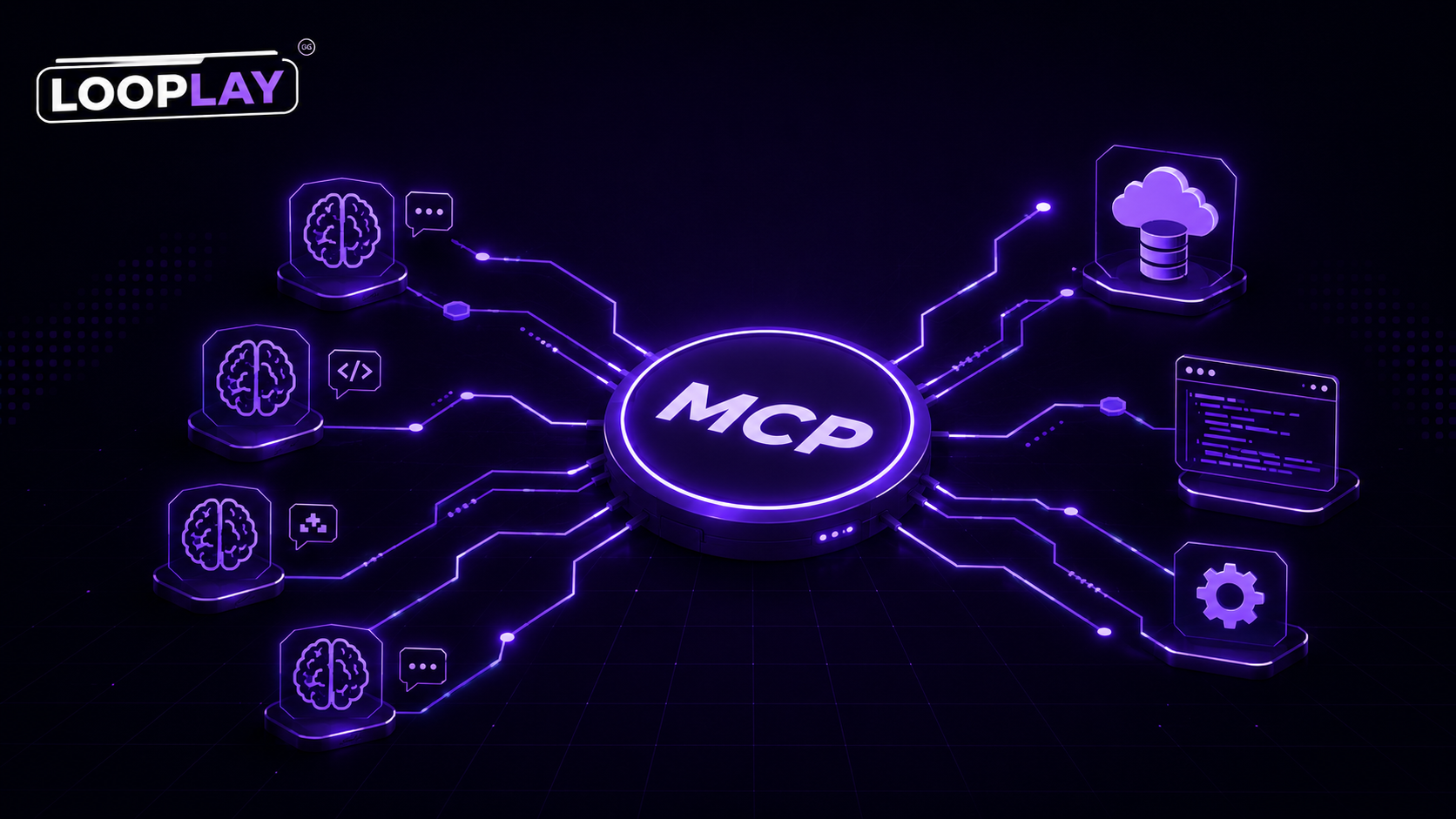
Most game developers vibe coding in 2026 are hitting the same wall — AI-generated code that looks right, fails at runtime, and costs more time to debug than it saved to generate. The missing piece isn’t a better model. It’s Model Context Protocol — MCP — the open standard that gives your AI agent eyes.
The missing piece isn’t a better model. It’s better context. Model Context Protocol — MCP — is what delivers it.
What Is MCP?
MCP (Model Context Protocol) is an open standard that lets AI agents connect to real external tools, data sources, and services so they build against your actual project instead of their best guess at it.
Think of it as USB-C for AI. Before USB-C, every device had its own proprietary cable. Before MCP, every AI-to-tool connection required custom integration code written from scratch. Want Claude to access your database? Custom connector. Want GPT-4 to do the same? Different connector. Ten AI models, twenty tools, two hundred custom integrations to build and maintain.
MCP collapses that. Build a tool once as an MCP server. Any MCP-compatible AI like Claude, ChatGPT, Gemini, Cursor, Copilot will connect to it immediately.
Anthropic open-sourced MCP in November 2024. OpenAI adopted it in March 2025. By December 2025, Anthropic donated the protocol to the Linux Foundation — co-founded with Block and OpenAI — making it a true open industry standard. Today, over 10,000 public MCP servers exist across registries. From internal experiment to infrastructure standard in 18 months.
How MCP Works
Three pieces:
Host — the AI application. Claude Desktop, Cursor, Looplay’s AI Game Builder. This is where the model lives and where you interact.
Client — the translator inside the host. It finds available MCP servers, converts the AI’s requests into MCP format, and converts responses back. The AI never touches external systems directly.
Server — the external capability. Your database, your Git repo, a game asset library, an on-chain data API. Any system that exposes its capabilities through MCP becomes available to any AI client.
The elegance: the AI doesn’t need to know how your database works. It asks for data. The server retrieves it. The client translates. Three layers, cleanly separated and infinitely composable.
Why MCP Matters for Game Development Specifically
Without MCP, a vibe-coded game is built in isolation. The AI generates code from training data that’s 12–18 months old. It can’t see your actual asset library. It doesn’t know your real file structure. It describes things correctly but against a world that doesn’t quite match yours.
MCP bridges that gap. The game-specific servers already in production:
PixelLab MCP — Describe a character, get a pixel art sprite generated and the integration code written in one conversation. Works with Unity, Godot, GameMaker, Love2D, Raylib. The creative loop that used to take four context switches now takes one.
MCP Unity — AI agents like Claude Code and Cursor can execute operations directly inside the Unity Editor: create GameObjects, query the hierarchy, run menu items. Not just generating code, actually applying it in your editor.
Context7 — Provides AI agents with version-specific framework documentation. When your agent generates Three.js r183+ code, it reads current docs, not 18-month-old training data. Fixes one of the most common sources of broken AI-generated game code.
Supabase MCP — Live databases in your AI workflow. Real leaderboard queries, actual player session data, live analytics. No more hardcoded test values that break when real players arrive.
What Happens When Your Game Is Fully Connected
This is what MCP actually unlocks a fundamentally different experience of building.
You describe a character: “a small wizard with a blue robe and a glowing staff.” The PixelLab MCP server generates the pixel art sprite. The AI writes the loading code using the correct asset path and places it in the right directory. You didn’t switch windows. You didn’t copy a path. You didn’t paste anything. One conversation, character done.
You ask for a leaderboard. The Supabase MCP server connects to your live database. The AI writes queries against your actual schema, the column names that exist, relationships that are real. The leaderboard doesn’t break when real players show up because it was built against real data from the start.
You generate Three.js physics logic. Context7 pulls the current r183+ documentation. The function signatures are correct. The deprecated APIs aren’t used. The code works because the AI is reading what’s actually there, not remembering what it learned 18 months ago.
You’re in Unity. You ask the agent to create a wave spawner and wire it to your existing enemy prefabs. MCP Unity executes the operations directly in your editor, the GameObject appears in the hierarchy, the references are set, the script is attached. The agent isn’t just writing code for you to paste. It’s doing the work.
That’s the end state. An AI that’s genuinely part of your workflow, not a smart autocomplete that you have to babysit and correct, but a collaborator that sees what you see and acts on what’s real.
This is the kind of connected, grounded workflow that platforms like Looplay are built to support, where AI builds games that work from day one, not after three rounds of debugging.
MCP vs Agent Skills
These get confused often. They operate at different layers:
Agent Skills (SKILL.md) — Tells the agent how to think, lives in your project directory, controls agent behavior.
MCP — Tells the agent what it can access, lives on external servers, controls agent access.
Skills for thinking. MCP for reaching.
If you want to go deeper on agent skills specifically, we covered the full picture in our previous post: AI Agent Skills for Vibe Coding Games: The 2026 Guide
In a solid vibe coding setup, both run together. Your ThreeJS skill defines architecture conventions. MCP servers give the agent real assets, live data, and current docs. Neither replaces the other.
MCP doesn’t make your AI smarter. It makes your AI accurate.
That’s the shift. And once you feel the difference — code that works on first run, assets that load, data that’s real — you won’t want to build without it.
The games worth building deserve infrastructure worth building on. Looplay is that platform.