

AI Agent Skills for Vibe Coding Games: The 2026 Guide
By Looplay Team
What agent skills are, why they change vibe coding games forever, and the pros use to vibe coding games in 2026.
You vibe code a game. The AI generates fast, the output looks clean, and then you run it, something breaks. A texture path that doesn’t exist. An audio function from the wrong library version. A component that assumes a canvas size that doesn’t match the renderer. You spend the next hour fixing code you didn’t write, for a game you haven’t actually built yet.
The model isn’t the problem. It’s working blind with no memory of your project structure, your asset library, your conventions. Every session starts from zero. That’s the gap agent skills close.
Looplay was built on this insight. The AI Game Builder that powers our platform runs on agent skill infrastructure because an AI that
guesses isn’t useful to a creator who just wants to describe a game and have it work.
Here’s what agent skills are and why they matter for anyone building games with AI in 2026.
What Are AI Agent Skills?
AI agent skills are reusable SKILL.md files that give AI that gives an AI coding agents persistent, specialized knowledge applied for a specific task including conventions, patterns, and quality rules the agent applies automatically whenever the context is relevant.
Think of it as a work manual. Once the agent reads it, it knows how to approach that domain and keeps applying that knowledge automatically across every file, every session, without being reminded.
Skills solve three problems that raw prompting can’t:
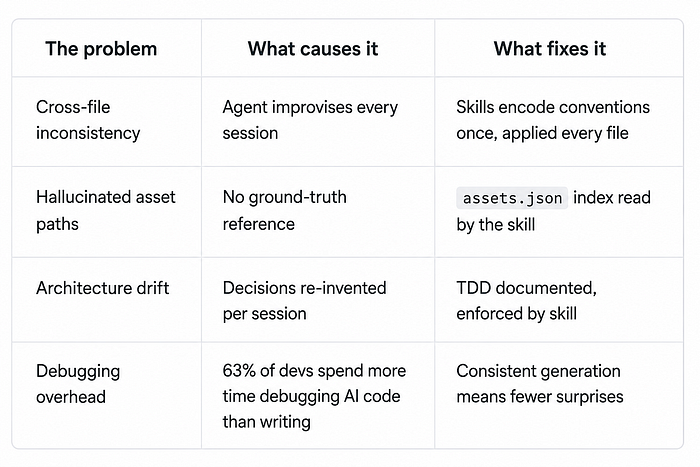
- Consistency: Without a skill, the agent improvises every session. With one, it follows the same conventions every time.
- Memory: Skills survive across sessions. Your ThreeJS architecture decisions don’t disappear when you close the terminal.
- Portability: The same
SKILL.mdfile works across Claude Code, Codex CLI, Cursor, Gemini CLI, Copilot, Cline, Windsurf, and more. One investment, every tool.
How AI Agent Skills Work
Every skill has two parts: frontmatter that tells the agent when to load it, and markdown that tells it what to do.
---
name: threejs-game-builder
description: Use when building 3D browser games with Three.js.
Applies scene conventions, animation loop patterns,
and asset management standards automatically.
---
# Three.js Game Builder
## Scene Setup
- Always use WebGLRenderer with antialias: true
- Set pixelRatio to window.devicePixelRatio
- Add resize handler on window
## Asset Management
- Load all assets from assets.json index - never hardcode paths
- Use GLTFLoader for all 3D models (.glb/.gltf)
## Game Loop
- Separate update() and render() functions
- Use Clock for delta time - physics must be frame-rate independent
The description field is the most critical part. It determines when the skill activates. Strong descriptions state triggers explicitly (“Use when the user asks to…”), not vague intent (“Helps with games”).
How Skills Load — Progressive Disclosure
Skills don’t dump everything into context upfront. At session start, the agent sees only each skill’s name and description roughly 100 tokens per skill. The full SKILL.md body loads only when the task matches. You can install dozens of skills with no meaningful overhead.
Why Vibe Coding Games Needs Agent Skills in 2026
The stat that matters: 92% of developers now use AI coding tools daily, and 46% of all new code is AI-generated but 63% report spending more time debugging AI code than writing it manually. For games, that debugging is almost always cross-file inconsistency. Skills fix it structurally.
The Essential Game Skills Stack
Some important skills builders are using right now to enhance and level up AI agents for vibe-coded games:
threejs-skills — The foundation for 3D browser game vibe coding. Covers scene setup, animation loops, lighting, camera, asset loading, and WebXR. Purpose-built for the vibe coding paradigm. npx skills add CloudAI-X/threejs-skills
webgpu-threejs-tsl — Extends Three.js for WebGPU. Updated April 2026 for Three.js r183+. Works in both Claude Code and Cursor from the same SKILL.md file via a thin .cursor/rules/ shim.
Godogen — Builds complete Godot 4 projects from game descriptions — architecture planning, GDScript generation, 2D/3D asset creation with Gemini/Tripo3D, visual QA via screenshot analysis. Works across Claude Code, Codex, and Gemini CLI.
frontend-design — Production-grade UI for HUDs and menus: dark mode, spacing, typography, micro-interactions. Turns mediocre AI UI into polished game screens.
tdd-workflow — Test-driven development, 90%+ coverage by default. Essential for physics, scoring, and state logic where bugs hide in edge cases.
The full community library lives at Github with over 1,000 skills, all compatible with Claude Code, Cursor, Codex, and Gemini CLI.
The Shift From Vibe Coding to Agentic Engineering
There’s a language shift happening in 2026 that’s worth understanding. Andrej Karpathy — who coined “vibe coding” in February 2025 called the next evolution “agentic engineering”: orchestrating AI agents as architect and reviewer, not prompting them as autocomplete.
The pattern is: concept → spec → agent builds → human reviews → iterate. Skills are what make each phase reliable. The ThreeJS skill keeps generation consistent. A game design document constrains scope. An engineering spec, generated by a high-reasoning model with your game skill loaded, locks the architecture before a single file is written. Then the agent implements with conventions always loaded, with an asset index as ground truth, with your architecture decisions intact across every file.
The output is categorically better than pure vibe coding. Not because of a smarter prompt. Because of structure at every stage.
Agent skills are the missing layer between vibe coding and shipping. Once you have the right skills installed — your ThreeJS conventions, your asset patterns, your architecture rules — the inconsistency problem largely disappears. The agent stops improvising and starts following a playbook you wrote once.
That’s the foundation Looplay was built on. If you want to build a game that goes further than the code this is where it starts → looplay.gg