

The Vibe Coding Loop: How to Build a Web3 Game with AI That Actually Verifies Itself
By Looplay Team
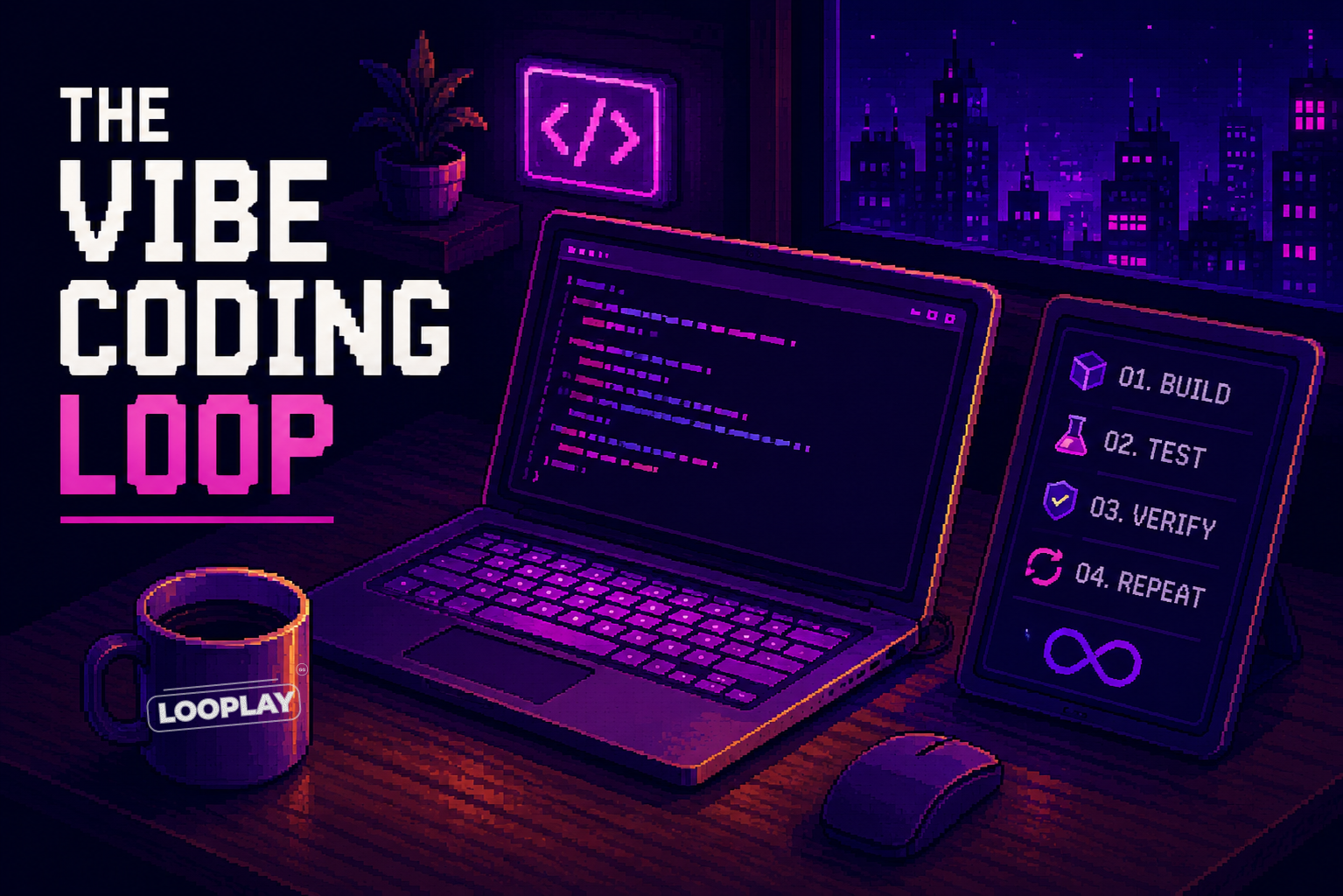
Vibe coding a web3 game means describing the game you want in plain language, letting AI generate a working build, and then running that build through a structured verify-and-iterate loop until it meets defined criteria rather than manually re-prompting and judging each version yourself.
Most explanations of AI loops stop at the same five-step diagram:
DISCOVER  →  work out what needs doing
PLAN      →  decide how to do it
EXECUTE   →  do the work
VERIFY    →  check it against the goal
ITERATE   →  not there yet? feed the result back in and repeat
Useful as a mental model, not especially useful when you’re staring at an empty prompt box trying to get a playable game out of it, particularly in web3, where the build also has to account for on-chain mechanics, fair-play guarantees, and economies that real money moves through. This is where most vibe-coded games quietly break: the gameplay loop feels fine, and the token layer underneath it doesn’t hold up. Platforms like Looplay, where players prompt games into existence and creators can take a successful build toward a token launch, are exactly where that gap shows up first.
This guide covers how to structure a vibe coding prompt that produces something worth keeping, how to verify an AI-generated game build instead of just eyeballing it, what changes when the game has tokens or NFTs attached, and where this approach genuinely breaks down.
What Makes an AI Loop Actually Work: The Verify Step
A loop without a real verify step isn’t a loop it’s an AI re-generating the same guess with more confidence each time. The verify step is what turns repetition into actual progress, and it’s the single most commonly skipped part of building a game with AI.
A single prompt gets you one output and stops. A loop is the same generation step run repeatedly against a defined check, with the AI correcting itself between passes instead of waiting for you to spot every issue manually.
The check is what makes it real. Ask an AI “is this game balanced?” with no criteria attached, and it will tell you yes almost every time, it has nothing concrete to measure against, so it defaults to agreement. The fix is to make the check external to the model’s own judgment wherever possible:
- A solver, not an opinion. For level generation, run the output through logic that confirms the level is actually completable not “does this look beatable” but a pathfinding check that proves it.
- A target number, not a vibe. For balance, define the win rate you want per difficulty tier or character, simulate outcomes, and measure the deviation. “Feels fair” isn’t a metric, the 48-52% is.
- A rubric, not a gut check. For dialogue or content variation, a tone-and-vocabulary rubric the output gets scored against catches drift that a quick read-through misses.
Where no external check exists and for most of what makes a game actually fun, none does, the loop still needs a human in the verify step. That’s not a limitation of the tooling. It’s the correct division of labor.
How to Write a Vibe Coding Prompt for a Game
A vibe-coded game prompt that holds up names four things precisely:
Build a [genre] game where the player [core action].
CORE LOOP: [the repeated player action - be specific, not generic]
WIN/LOSE CONDITION: [the exact threshold - time, score, or attempt count]
DIFFICULTY CURVE: [how and when it escalates]
FEEL: [pace and tone - this is what differentiates your build]
A filled example: “Build a browser game where the player taps falling objects to score points. Core loop: tap before they hit the ground. Win/lose: three misses ends the run. Difficulty: speed increases every 15 seconds. Feel: bright, cartoonish, score visible at top.”
Vague core loops are the most common failure point. “Build a fun platformer” gives the model nothing to anchor on, and it will fill the gap with the most generic interpretation available. Naming the exact repeated action is what separates a prompt that produces a first draft worth refining from one that produces a tech demo.
How to Run an AI Iteration Loop on a Game Build
Once a first build exists, the loop step is what separates re-prompting by hand from an AI that corrects its own output against criteria you set once:
Iterate on this build until it meets the bar below.

SUCCESS CRITERIA (score 1–10 each, be strict - no soft passes):
- Core loop holds up after 10+ playthroughs
- Difficulty ramp creates tension, not frustration
- Win/lose feels earned, not arbitrary
- No dead time - something is always happening on screen

EACH PASS:
1. Identify the single lowest-scoring criterion.
2. Make one specific change that targets only that criterion.
3. Re-score all four against the new build.
4. If every score is 8 or above, stop and report FINAL.
   Otherwise, report ITERATING and continue.

Make reasonable assumptions rather than asking clarifying questions; note any assumption made.
In practice this takes three to five passes before a build actually feels different rather than just looking different. If the model reports FINAL after one pass, it isn’t genuinely scoring itself against the criteria, treat that as a signal to push back, not as a result to trust.
What’s Different About Vibe Coding a Web3 Game vs a Regular Game
Web3 games carry constraints a normal prompt-and-iterate loop won’t surface on its own, because nothing in a generic game-balance check accounts for real value moving through the system. Three are worth building into the verify step explicitly:
Fairness has to be provable, not just felt. Any randomness like loot drops, lottery mechanics, reward rolls need a verifiable source, typically a verifiable random function, rather than client-side pseudo-randomness a player or bot could predict or manipulate. This isn’t a vibe-coding concern in a normal game; in a game with a payout attached, it’s the first thing to get checked.
Session and reward data should be validated server-side. If progress, play time, or in-game achievements feed into any kind of reward or token mechanic, client-reported data is trivially fakeable. The verify step for a web3 build needs to ask not just “does this feel fun” but “can this result be trusted,” which usually means server-side validation of the events that matter, not just the client UI reporting them.
Economic balance is a harder target than gameplay balance. A normal game loop tunes for fun. A token-backed game also has to tune for an economy that doesn’t collapse, reward issuance has to stay below whatever is funding it, and “balanced” now means a sustainable emission curve, not just a fair win rate. Treat this as a separate verify pass with its own numeric targets, not folded into general game-feel scoring.
None of this changes the core loop mechanics described above. It adds a second verification track running alongside the gameplay one. One checks whether the game is fun, the other checks whether the economy and fairness guarantees actually hold.
What loops well and what doesn’t
Three categories of game-building work hold up well under this approach, because each has a verifiable target:
Level and content generation, checked against a solver or completion proof rather than visual inspection.
Balance and economy tuning, checked against target numbers rather than impressions, this matters as much for token reward curves and drop rates as it does for difficulty.
Variation at scale, dialogue, enemy behavior, flavor text. Checked against a consistency rubric, which is where a loop produces more usable output in an afternoon than manual writing would in a week.
What doesn’t loop, and isn’t close to looping: whether a game is actually fun. There’s no test that returns a pass/fail on enjoyment. Every build still gets played by a human, every time, before it ships that step doesn’t get automated away by any version of this workflow available today.
Why AI Iteration Loops Cost More Than They Look Like They Should
Each iteration re-sends its full context to the model: the goal, every prior pass, what failed and why. That context grows with each round, so five iterations cost meaningfully more than five times a single prompt, not the same amount repeated.
The metric worth tracking is cost per result actually kept, not cost per iteration run. Discarding half of what a loop produces means the review overhead is eating the time savings the loop was supposed to provide. A loop without a real stop condition doesn’t fail loudly it keeps running and consuming budget while producing nothing usable, which is a more expensive failure mode than an obvious crash.
The sequence that holds up in practice: get one version reliable manually first, then formalize it into a repeatable prompt structure, then let it iterate on its own. Automating a step before it’s proven by hand is the most common way this goes wrong and in a web3 context, where a bad economic assumption can ship to a live token, it’s the most common way this goes wrong expensively.
Looplay is one of the platforms putting this workflow into practice: prompting, publishing, and growing a web3 game in a single pipeline. If you’re building one yourself, looplay.gg is worth a look.