

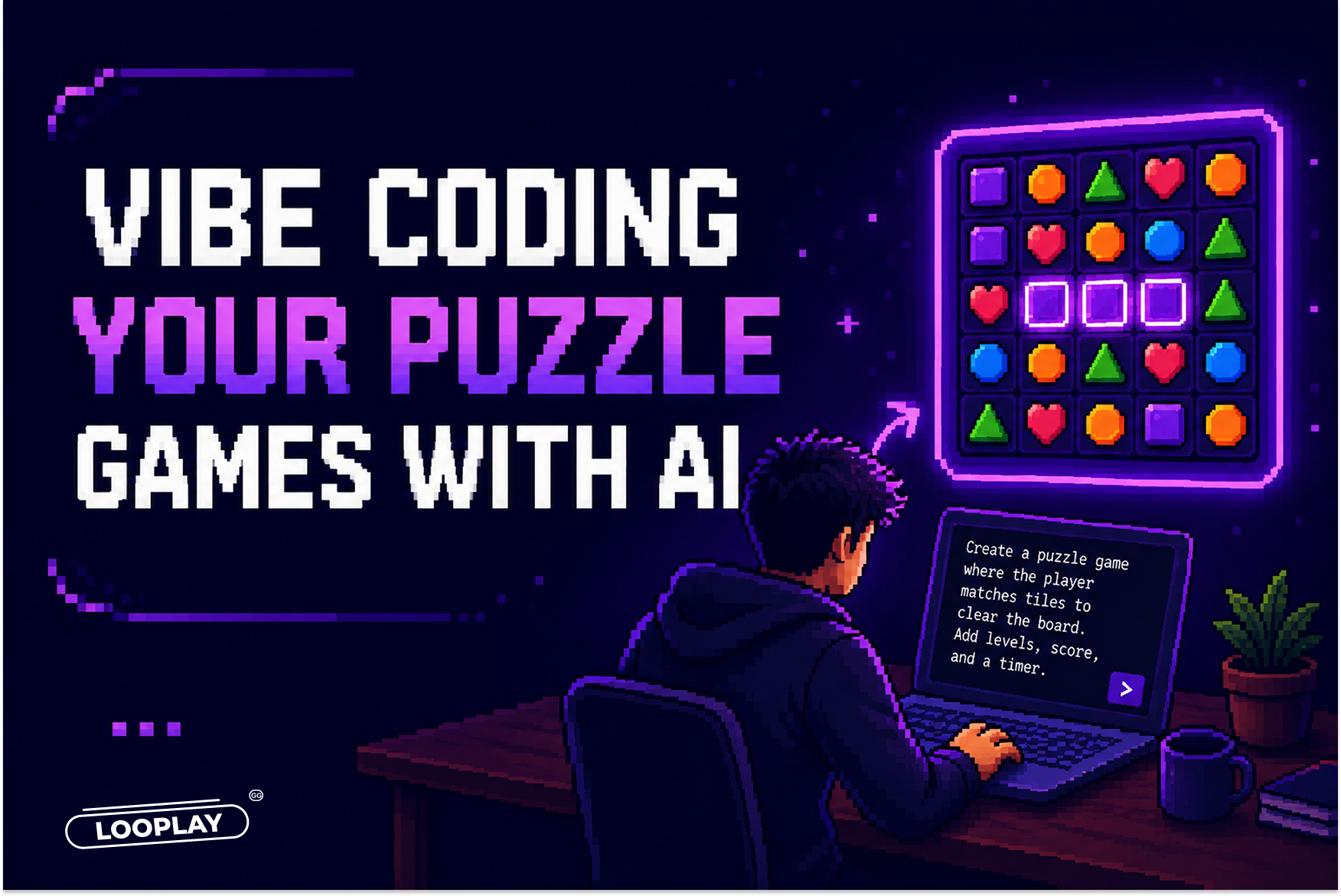
Every great game has one moment that matters: the click — the instant a player stops thinking about the controls and just plays. Land it and they feel brilliant. Miss it and they’re gone. For most of gaming’s history, chasing that moment meant building one version by hand, testing it, scrapping it, and starting over.
AI kills that grind. Instead of crafting a single version, you can explore dozens like an easy warm-up, a Sunday challenge, and a brain-bender for veterans, all described in a sentence and built in minutes. The machine assembles; you judge. Keep what clicks, cut what doesn’t.
It looks like a productivity tip. It’s actually the cleanest demonstration of the biggest shift in how things get built right now: vibe coding — creating by describing instead of by hand.
Describe It, Don’t Build It
Instead of writing the instructions yourself, you describe the outcome and let the AI write the instructions for you. You say what you want, it builds, you say what to change, it changes. The loop runs in minutes. The human brings intent and judgment; the machine brings execution.
Meta’s puzzle tutorial is the clearest example because puzzles are simple enough that nothing gets in the way. Ask for “a 15-question trivia quiz about Premier League history, medium difficulty, answer key separate” and you’ll have a finished quiz before your coffee cools. You never touched a grid editor. You described, and it built.
What kinds of games can you make?
More than most people expect from a single prompt. Today’s AI tools can generate:
Arcade games — a reaction-time challenge, an endless runner, a brick-breaker. Fast to build, instantly playable, easy to tune.
Puzzle games — memory matches, tile sliders, word games, logic challenges. The clean rules make them ideal first projects.
Quiz and trivia games — themed question sets with scoring, timers, and lives. Great for communities and events.
Casual mobile-style games — tap, swipe, and timing games that feel at home on a phone.
Each one can be generated as a working file you open and play right away. The point isn’t that the first version is perfect it’s that you go from idea to something playable before you’ve lost the thread of inspiration.
How to write a prompt that builds a good game
The difference between a flat game and a fun one usually lives in the prompt. Vague in, vague out. A strong game prompt names four things:
- The core loop: What does the player actually do, over and over? “Dodge falling blocks,” “match three tiles,” “answer before the timer runs out.” This is the heart of the game so be specific.
- The win and lose conditions: “Survive 60 seconds,” “reach 1,000 points,” “three misses and it’s over.” Clear stakes make a game feel like a game.
- The difficulty curve: “Speed increases every 10 seconds,” “questions get harder each round.” This is what creates tension and tension is what keeps people playing.
- The feel: Pace, theme, mood. “Fast and frantic,” “calm and meditative,” “retro arcade style.” Feel is what makes your game yours.
A complete prompt might read: “Build a browser game where the player taps falling fruit to score points. Speed increases every 15 seconds, three misses ends the game, and the style is bright and cartoonish. Show the score at the top.” That single sentence is enough to get a playable first build.
How to make your game actually good
The first version is a starting point, never the finish line. Great results come from the same loop every time: generate, play, refine.
1.Play it before you judge it: You can’t tune what you haven’t felt. Play your own game first, every time.
2. Fix one thing per pass: Don’t ask for ten changes at once. “The jump feels floaty — make gravity stronger.” “Add a point counter.” “Make the early levels easier.” Small, specific instructions get clean results.
3. Chase the fun, not the features: The temptation is to keep adding. Resist it. A simple game that feels great beats a complex one that doesn’t. Ask yourself after each pass: do I want to play one more round? If yes, you’re close.
4. Test it on someone else: What’s obvious to you may baffle a new player. Hand it over, watch them play, and let their confusion tell you what to fix.
These habits are the real skill of vibe coding. The AI builds fast and you’re the one who decides when it’s good.
Why this matters
For most of gaming’s history, the people with ideas and the people who could build them were two different groups. Vibe coding erases that line. A teacher can build a classroom game. A streamer can build something for their community. A kid with an idea at the dinner table can have a playable version before dessert.
The barrier was never imagination, it was the gap between having an idea and shipping it. That gap is closing fast, and it’s measured in sentences now, not semesters.
Start with one prompt
The only way to understand vibe coding is to do it. Open an AI assistant and try one:
“Build a simple browser game where I catch falling stars in a basket. Speed increases over time, and I lose if I miss three. Keep score at the top.”
A minute later you’ll be playing something that didn’t exist when you started reading. That moment — I described it and it became real — is the whole idea in miniature. Everything bigger is just the same loop, repeated.
That loop is what we’re building around at Looplay, a place where describing a game and getting it in front of real players are becoming the same short journey. If the “describe it and it’s real” feeling is one you want to chase past a single prompt, see what’s next at looplay.gg.