

DeepSeek V4: The AI Model Series Built for Vibe Coding Games in 2026
By Looplay Team
DeepSeek just released V4 with two MoE models (Flash at 284B params, Pro at 1.6T params), both with 1M-token context, MIT license, and three reasoning modes. In 2026, where 46% of all new code is AI-generated and the vibe coding market hit $4.7B, DeepSeek V4 Pro-Max is the best open-source model for generating complete, multi-file games.
With this release, platforms like Looplay — where you can vibe-code games with AI directly just by prompt — are benefiting directly from this leap.
What Is DeepSeek V4?
DeepSeek V4 is a series of two Mixture-of-Experts (MoE) language models released in 2026 with DeepSeek-V4-Pro (1.6T total parameters, 49B activated) and DeepSeek-V4-Flash (284B total parameters, 13B activated), both supporting a context length of one million tokens and released under an MIT license.
As of 2026, it’s one of the most suitable models for AI game creation platforms like Looplay.gg.
The series is designed for advanced reasoning, coding, and long-horizon agent workflows: full-codebase analysis, multi-step automation, and large-scale information synthesis. For vibe coding games specifically, the 1M-token context window and three-tier reasoning system address the most common failure mode in AI game generation.
The DeepSeek V4 Series: Four Models, Two Tiers
DeepSeek V4 is a family of two Mixture-of-Experts (MoE) language models, both supporting a context length of one million tokens and released under an MIT license:
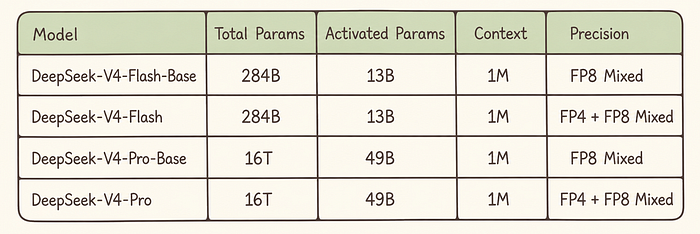
Flash: Fast, efficient, 284B total parameters with 13B activated. Great for quick prototypes, simple arcade games, and rapid iteration. DeepSeek-V4-Flash-Max achieves comparable reasoning to Pro when given a larger thinking budget, though it sits slightly behind on the most complex multi-file tasks.
Pro: The full-power model. 1.6T total parameters, 49B activated. Designed for advanced reasoning, coding, and long-horizon agent workflows. Full-codebase analysis, multi-step automation, large-scale synthesis. This is the one for complex games with multiple systems, scenes, and interdependencies.
Both are pre-trained on more than 32 trillion tokens, with a two-stage post-training pipeline: independent cultivation of domain-specific experts through SFT and RL with GRPO, followed by unified model consolidation via on-policy distillation.
What Makes DeepSeek V4 Different from Other AI Coding Models?
1. Hybrid Attention (CSA + HCA) The series uses a hybrid attention mechanism combining Compressed Sparse Attention and Heavily Compressed Attention to handle the 1M-token context efficiently. At full 1M-token context, DeepSeek-V4-Pro requires only 27% of single-token inference FLOPs and 10% of KV cache compared to DeepSeek-V3.2. Long context without the compute cost.
2. Manifold-Constrained Hyper-Connections (mHC) Strengthens residual connections to keep signal stable across deep layers the model maintains coherent intent from the planning phase all the way through to the last generated file.
3. Muon Optimizer Used for faster convergence and greater training stability, which translates to more consistent, reliable code output across different game types and frameworks.
Reasoning Modes: Non-Think, High, Max
Both Flash and Pro support three reasoning effort modes:
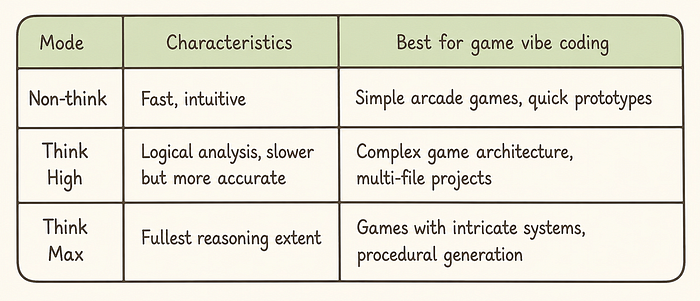
On OpenRouter, reasoning efforts high and xhigh are supported -xhigh maps to Think Max. Access the reasoning_details array in the response to see the model's step-by-step thinking.
DeepSeek-V4-Pro-Max — the Think Max mode of Pro — is described as the best open-source model available today. The benchmarks back it up:
- LiveCodeBench (Pass@1): 93.5 — above Gemini-3.1-Pro High (91.7) and Opus-4.6 Max (88.8)
- Codeforces Rating: 3206 — highest among all compared frontier models
- SWE Verified (Resolved): 80.6 — on par with the best closed-source models
Why 1M Context Changes Game Vibe Coding Specifically
63% of developers report spending more time debugging AI-generated code than writing it manually. For game vibe coding, the #1 cause is cross-file inconsistency the game loop references a class that doesn’t export what it expects, state management is defined differently across components, physics and scoring don’t share the same data model.
These failures happen because most models lose coherence as the codebase grows beyond their effective context. DeepSeek V4’s 1M-token window made practical by the CSA + HCA hybrid attention, means the model sees every file simultaneously when generating or modifying any individual one.
The transition from vibe coding to “agentic engineering” is the defining shift of 2026, where AI agents handle implementation while humans provide architecture and review. DeepSeek V4 Pro’s Think Max mode is built for exactly this: you define the architecture, the model handles full-codebase implementation with explicit reasoning at every step.
Which DeepSeek V4 Model Should You Use to Build Games?
DeepSeek-V4-Flash, Non-Think → you want fast output for a simple game concept. Prototyping, game jams, quick experiments.
DeepSeek-V4-Flash, Think High/Max → you need more reasoning but want to keep costs lower. Flash-Max gets close to Pro-level on reasoning tasks with a larger thinking budget.
DeepSeek-V4-Pro, Think High → a complete multi-file game with real systems. This is the everyday pick for serious vibe coding projects.
DeepSeek-V4-Pro-Max (Think Max) → the most complex projects. Multiple interconnected systems, procedural generation, full game economies. The best open-source model available for this use case, period.
Why Is DeepSeek V4 the Best AI Model for Vibe Coding Games in 2026?
The adoption war is over. The differentiator in 2026 is whether you test what AI produces, whether you catch the broken reference before your users do.
DeepSeek V4 gives you the model that generates coherent, complete, production-worthy game code. Platforms like Looplay, which lets creators describe, build, and monetize games with an automatic token economy on BNB Chain, are using this capability tier because 1M-context game generation is now reliable enough to ship as a product, not just a demo.
For full API documentation, model weights, and benchmark details, see the official resources in Hugging Face or DeepSeek main page.