
Claude Sonnet 5 vs Grok 4.5 vs Kimi K3: Which AI Model Is Best for Vibe Coding Games in 2026?
By Looplay Team
.png&w=3840&q=75)
Three frontier AI models shipped within ten days of each other in July 2026: Claude Sonnet 5 (June 30), Grok 4.5 (July 8), and Kimi K3 (July 16). None of them is the clear winner across the board. The right answer depends entirely on which phase of the vibe coding game workflow you’re in.
What Are Claude Sonnet 5, Grok 4.5, and Kimi K3 and How Do They Differ for Game Development?
Claude Sonnet 5, Grok 4.5, and Kimi K3 are three frontier AI coding models released within ten days of each other in July 2026, each optimized for a different strength: agentic reasoning and structured output, speed and cost efficiency, and front-end visual output respectively. Here’s the at-a-glance picture:
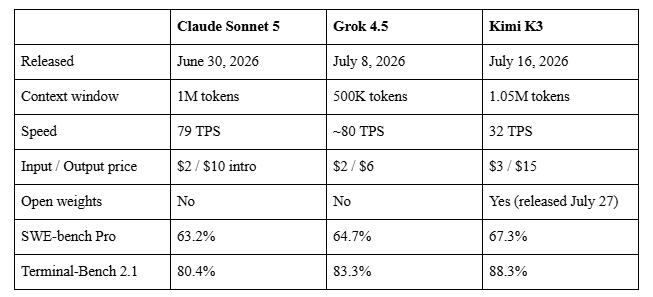
On SWE-bench Pro, which measures real repository-scale bug fixing, all three models cluster within 4 points: Kimi K3 leads at 67.3%, Grok 4.5 at 64.7%, Sonnet 5 at 63.2%. That gap is too small to be a meaningful differentiator. The real separation shows on Terminal-Bench 2.1, which measures sustained agentic task completion in a shell environment: Kimi K3 leads at 88.3% (vendor-reported, KimiCode harness), Grok 4.5 at 83.3%, Sonnet 5 at 80.4%. These two benchmarks test different capabilities: repository comprehension vs. sustained agentic execution, and both matter for a vibe coding game workflow.
Which Model Is Best for Planning a Game?
After using and testing all 3 Models, in our perspective, Claude Sonnet 5 is the strongest choice for the planning phase: defining mechanics, mapping systems, thinking through edge cases before any code gets written.
Its extended thinking mode produces deliberate, structured output optimized for reasoning over ambiguous problems. When the task is “think through this mechanic and identify what will break before building it,” Sonnet 5’s careful, methodical reasoning is a genuine asset. Grok 4.5 sits close behind, it asks the right clarifying questions before generating and performs at a comparable quality level for brainstorming. Kimi K3’s training emphasis on long-horizon autonomous execution means it tends to make decisions on behalf of the developer rather than surface options for discussion, which is more useful later in the build than during early planning.
Which Model Is Best for Building Game Features?
We think Grok 4.5 wins for sustained implementation, the phase where the plan is locked and the goal is to execute fast without breaking flow state.
At 80 tokens per second, it’s the fastest of the three by a significant margin. Kimi K3 at 32 TPS is less than half the speed, a gap that compounds quickly in iterative sessions where each pass needs to arrive before the developer loses the thread. Speed here isn’t cosmetic. It changes how ambitiously builders prompt, because fast feedback makes experimentation feel cheap. On output cost, Grok 4.5 is also the clear winner at $6 per million output tokens, cheap enough to run as a single model from brainstorm through to final implementation without switching down for execution, keeping full context continuity across the session.
Which Model Is Best for Visual and Front-End Game Code?
Kimi K3 wins on front-end and visual output, the phase where the game needs to look and feel right, not just function correctly.
In blind Arena evaluations, developers preferred K3 over every other tested model for front-end coding, including Claude Fable 5 and GPT-5.6 Sol, earning 1,679 Elo on the Frontend Code Arena leaderboard. For vibe-coded games where animation timing, particle effects, and UI polish matter, K3’s “vision in the loop” capability adds a meaningful edge, it can iterate directly on live screenshots of the game state rather than relying on text descriptions of visual problems. The describe-see-fix cycle closes inside the model itself, compressing what would normally take three or four correction passes into one. K3 also holds the largest context window of the three at 1.05M tokens, making it the natural choice for longer sessions where the full project needs to stay in view. And as of July 27, its full weights are publicly released under a Modified MIT license, making self-hosting viable for teams with the infrastructure to run a 2.8T-parameter model.
Which AI Model Should Vibe Coders Actually Use for Game Development?
The honest answer is that the best vibe coding game workflow in July 2026 doesn’t pick one model, it routes by phase.
Sonnet 5 for planning, because its extended thinking mode catches problems before the first line of code gets written. Grok 4.5 for implementation, because at 80 TPS and $6 output it keeps the iterate-and-test loop moving without burning through budget. Kimi K3 for front-end and visual polish, because it’s the only model in this cohort that can look at a screenshot of what you built and fix what’s wrong without you narrating the problem.
If that sounds like overhead, there’s a simpler version: run one model, make it Grok 4.5. On SWE-bench Pro the three models are within 4 points of each other, close enough that speed and cost become the deciding factors at that tier. Grok 4.5 wins both, at $2/$6 per million tokens with no tokenizer inflation and 80 TPS output. That combination makes it the most practical all-rounder for a vibe coding game workflow end to end.
One pricing nuance worth knowing before committing: Sonnet 5’s intro rate of $2/$10 inflates by ~35-42% due to its new tokenizer, pushing real cost to approximately $2.84/$14.20, closer to its post-August pricing than the headline suggests. Kimi K3’s $3/$15 is offset by a 90%+ cache hit rate on coding workloads, significantly reducing effective session cost. The model that looks most expensive in isolation often isn’t the most expensive in practice.
Three models, ten days, three different bets on what the vibe coding workflow actually needs. The right one depends on where in the build you are but the builders who understand the difference will ship meaningfully faster than those who don’t.