

AI Agent Architecture for Game Developers: A 2026 Technical Guide
By Looplay Team
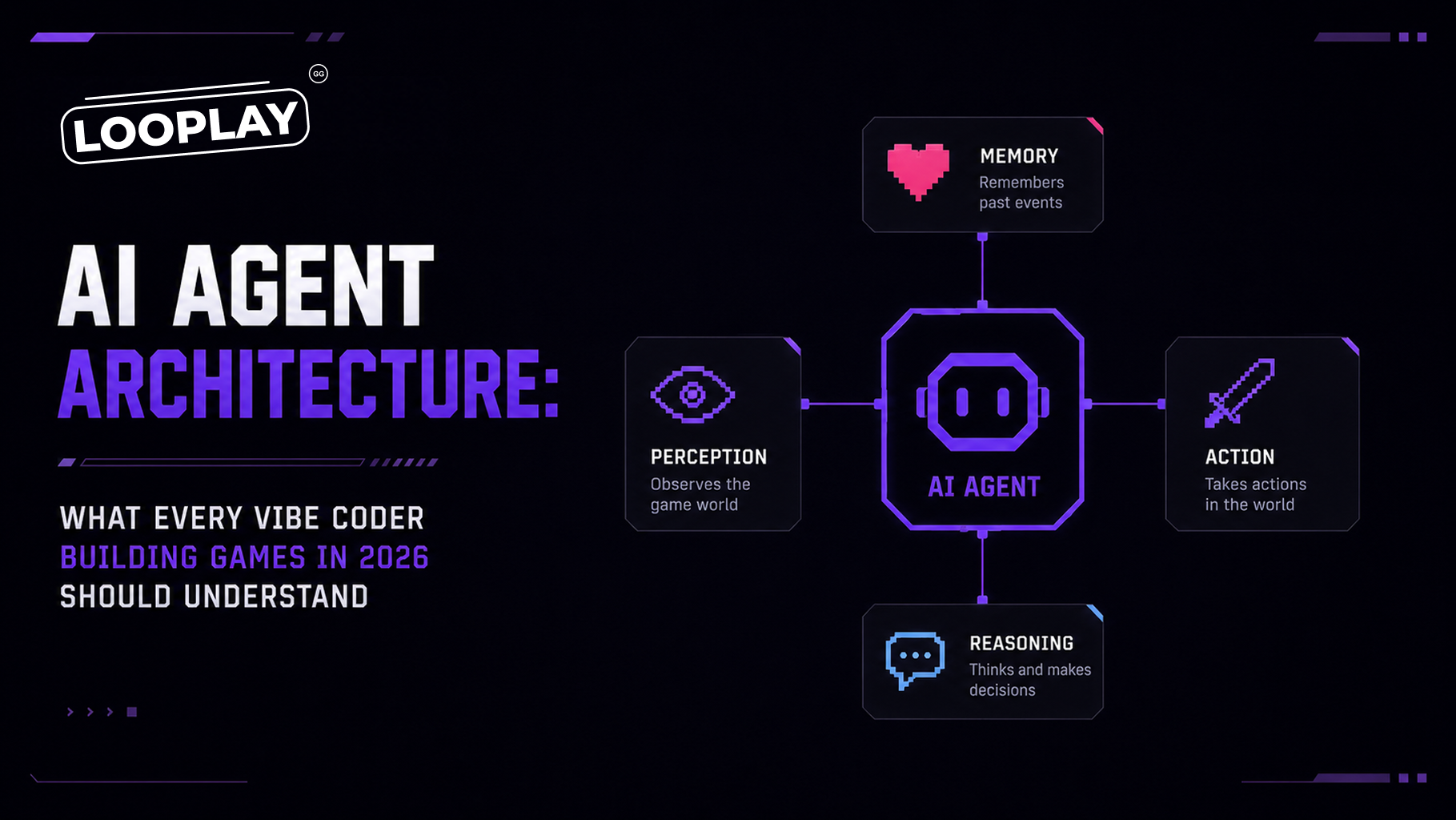
In 2026, the developers shipping games with real replay value have learned something vibe coding tools don't teach: the code agent is one layer of a five-layer architecture, and it's not the most important one.
This is a breakdown of that architecture, each layer defined, explained, and mapped to concrete decisions you make when building a game with AI tools.
The Five-Layer Pipeline
AI agent architecture is a five-layer system — perception, memory, reasoning, action, and feedback that allows an AI system to observe inputs, recall past context, make dynamic decisions, execute real actions, and improve over time. In games, these layers map directly to how a game observes players, remembers their history, adjusts behavior, fires events, and compounds learning across sessions.
Remove any one layer and the agent degrades in a specific, predictable way.
1. Perception - Transforms raw inputs (player events, API responses) into normalized, validated data the reasoning engine can trust. A broken perception layer means everything else acts on noise.
2. Memory - Three distinct types: working memory (current session context), episodic memory (structured logs of past sessions, queryable by time and outcome), and semantic memory (compressed stable facts like player skill tier, stored in a vector database).
3. Reasoning - Where an agent uses goals, constraints, and chain-of-thought steps to decide which action best serves a defined objective. This replaces hardcoded difficulty lookup tables with dynamic policies.
4. Action - Where the agent's decision becomes real: adjusting difficulty, spawning a reward, changing NPC behavior. In 2026, MCP connectors make this layer composable, expose game parameters as named tool interfaces once, and any reasoning layer can call them by name.
5. Feedback - Logs what the agent decided, measures the outcome against the goal, and updates the player's memory profile. Without this, you have a pipeline, useful but frozen. This is what makes the system truly agentic.
Layer 1 — Perception: Your Event Schema Is the Foundation
The perception layer in a game is the event schema — the structured definition of what the game observes about each player action, how that data is formatted, and what gets validated server-side. A win at 40 seconds is a different signal than a win at 4 minutes. Without a consistent schema, downstream agents act on incoherent data.
Practical pattern: Write the full event interface as a single typed file before touching any game logic. This file is also the first context block in your CLAUDE.md — AI coding tools need to understand the schema before generating game logic that produces events.
interface GameEvent {
  type:       'session_start' | 'win' | 'loss' | 'quit'
  player_id:  string   // verified — never trust client-reported identity
  session_id: string   // server-assigned at session_start
  ts:         number   // unix ms — always server-side
  payload:    WinPayload | LossPayload | QuitPayload
}

interface WinPayload {
  elapsed_ms:   number
  strategy_tag: string  // "aggressive" | "defensive" | "balanced"
  difficulty:   number  // 0–1, the value the reasoning agent set this session
  score:        number
}
The difficulty field records what the reasoning layer decided before the session began, so the feedback layer can later evaluate whether that decision produced better engagement. Without it, the loop can't close.
Layer 2 — Memory: Three Tiers, Three Backends
Most vibe-coded games implement only working memory, leaving episodic and semantic entirely unbuilt. Here's what you're missing:
Working memory - current session context, in the token window. Handled by accident. Trim aggressively; stale context degrades retrieval precision.
Episodic memory - specific past sessions with full temporal context: who did what, when, and what the outcome was. In 2026, Letta and MemGPT-style systems handle this with page-in/page-out summaries, giving agents a coherent narrative across sessions without blowing up the context window. Mem0's April 2026 algorithm showed a +29.6 point improvement on temporal queries — exactly what a game memory system runs most.
Semantic memory - stable compressed facts about the player (skill tier, preferred strategy, average session length), stored in a vector database and updated after each session. It's what makes a new session feel like a continuation rather than a reset.
Layer 3 — Reasoning: ReAct, LangGraph, and Dynamic Difficulty
The reasoning layer replaces hardcoded game logic with dynamic policies. In 2026, 68% of production LLM agent deployments use some form of the ReAct pattern as their default reasoning loop.
ReAct (Reasoning + Acting) interleaves chain-of-thought steps with tool calls. A ReAct agent at session start doesn't pick difficulty from a table, it reasons step by step, calls memory tools, observes results, then makes a calibrated decision:
# Thought: Player quitting when difficulty > 0.75. Check profile.
# Action: get_profile("p_789")
# Observation: aggressive style, avg_session 380s, reward_sensitivity high
# Thought: Cap difficulty at 0.65. Increase reward frequency.
# Action: set_session_config(difficulty=0.65, reward_freq="high")
LangGraph encodes agent logic as a stateful, inspectable directed graph with checkpointing — nodes for computation, edges for control flow, state snapshots that let the agent pause on a player action and resume exactly where it left off. Use it when you need to debug wrong decisions or add human-in-the-loop steps without refactoring.
Framework guide:
- ReAct → session-start decisions (difficulty calibration, reward config). Best starting point.
- LangGraph → in-session adaptive agents (dynamic NPCs, live quest adjustment). Move here when auditability matters.
- CrewAI → multi-agent orchestration when a game agent, reward agent, and analytics agent must coordinate.
Layer 4 — Action: Expose Your Game as Tool Interfaces
The most common mistake in vibe-coded games is coupling action logic to the reasoning code — the agent reads game state and mutates it in the same function. When you swap the reasoning strategy, the action surface changes with it and everything needs retesting.
The clean pattern exposes game parameters as named MCP-compatible tools:
typescript
const gameTools = [
  {
    name: "set_difficulty",
    description: "Set session difficulty 0–1. >0.75 triggers quit risk.",
    fn: (d: number) => session.setDifficulty(d)
  },
  {
    name: "spawn_reward",
    description: "type: 'small'|'medium'|'jackpot'. delay_ms: when.",
    fn: (t, d) => rewards.schedule(t, d)
  }
]
// Swap ReAct for LangGraph: same tools, zero game code changes
The reasoning layer calls by name. It never touches game internals. Each tool is independently testable. Every call logs automatically into layer 5.
Layer 5 — Feedback: Build It Before You Launch
The feedback loop has four components:
- Decision log - record the reasoning trace, not just the outcome. You can't evaluate a choice without knowing what alternatives were considered.
- Outcome measurement - the metric must match the goal exactly. "Session length > 400s" or "return within 24h" — measure what the reasoning layer actually optimized for.
- Policy update - write outcomes back into the player's semantic memory profile after each session.
- Cohort analysis - distinguish player-specific signals (profile updates) from player-type signals (policy changes).
A game with a working feedback loop improves continuously. A game without one is frozen at launch quality. Over 60 days, that gap compounds into a retention difference that no amount of new content can close.
The Right Build Order
Most vibe-coded games start with the action layer and work backwards. The architecture that ships well reverses this:
- Define the perception event schema first, before any game logic
- Choose memory backends, before writing player-state code
- Expose the action surface as named tool interfaces
- Wire the feedback loop before launch, the decision log cannot be reconstructed retroactively
- Build the reasoning layer last,start with ReAct, move to LangGraph when needed
Now your vibe coding tools like Cursor, Claude Code, Windsurf are amplifying a coherent architecture. Agents amplify what's already there. Build something worth amplifying.
At Looplay.gg, we built this architecture into the platform so creators don't have to. The SDK handles server-side perception (verified session hashing, anti-bot validation), structured episodic memory (Alpha Points as a queryable engagement record), and automated feedback loops (bracket assignment updating per session, on-chain outcome writes). Three hooks: onSessionStart, onPlayTime, onWin and the infrastructure is already running.
The game is yours to build. The architecture underneath it doesn't have to be.